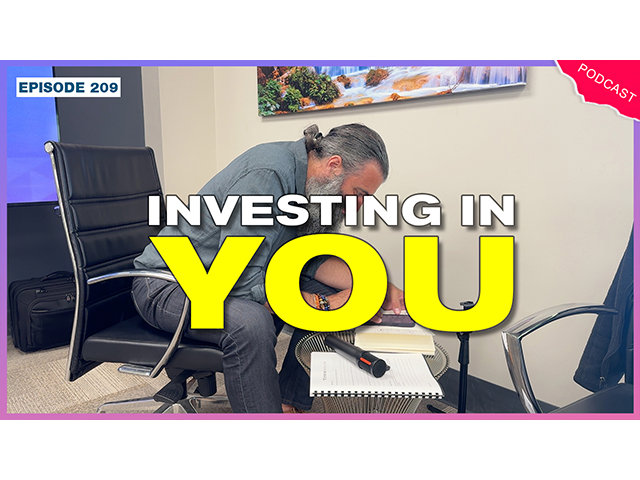
You invest in your business every day. When was the last time you invested in yourself?
Most founders and CEOs pour everything into growth – time, energy, money – and call it responsible. But when the tank is empty, the business suffers too. Your decisions get worse. Your patience disappears. The people closest to you feel it.
In this episode, Stephanie Vedder and Jovanni Godina break down what investing in yourself actually looks like, and why it has nothing to do with another course or conference.
Here is the gold from this conversation:
- It is not time management, it is you management. You cannot manage time. You can only manage where your energy goes. And most leaders are directing all of it toward work.
- Small investments compound. A five-minute meditation. A 20-minute walk. Journaling before you open your inbox. These are not luxuries. They are the compound interest of your wellbeing.
- Consistency is the real challenge. Knowing what to do is simple. Doing it every day when urgency is screaming at you – that is the work. And when consistency breaks down, there is usually something under the surface pulling you off track.
- Intention without attention changes nothing. You can set the intention to take care of yourself. But if your attention stays locked on the to-do list, you will never get the return.
The question is not whether you can afford to invest in yourself. It is whether you can afford not to.
Listen to the podcast below:
More Business More Life® Podcast Episode 209
The More Business More Life® podcast has been recorded by Napolitan Inc. It is hosted by the company’s Podbean channel and you can subscribe to the podcast on your favorite apps as follows:



Steve Napolitan
Related posts
Everyone's telling you to deploy AI right now. Almost no one's asking why. Here's the thing. AI accelerates whatever you already have. Good systems get better. Broken systems break faster. So if your processes are a mess and your strategy is fuzzy, AI won't hide that. It'll put it on a billboard. Which means the work isn't the tool. The work is knowing your business first.